Planter Maintenance: Critical Components for Corn and Soybean Success
TL;DR
Planter maintenance is one of the most profitable time investments Ohio farmers can make. Properly maintained planters improve seed spacing, depth, and emergence, protecting 10–20 bushels per acre in corn and up to 13 bushels per acre in soybeans. The three most critical components to check each season are parallel arms, gauge wheel arms, and disk openers - the foundation of consistent seed placement and yield potential. Meter maintenance and drive system performance also play a critical role in overall planter accuracy.
Key Takeaways
- Planter wear directly affects yield. Even ½ inch of slop in row units can cost you 10+ bushels per acre.
- Parallel arms control the stability of the row unit and seed depth consistency and angle the seed is released into the trench.
- Gauge wheel arms manage furrow integrity and planting depth.
- Disk openers create the ideal V-shaped trench for seed-to-soil contact.
- Seed tube guards impact trench shape—worn guards create a narrower trench and reduce proper seed placement.
- Regular inspection after harvest and before planting prevents preventable yield losses.
- Never skimp on planter maintenance.
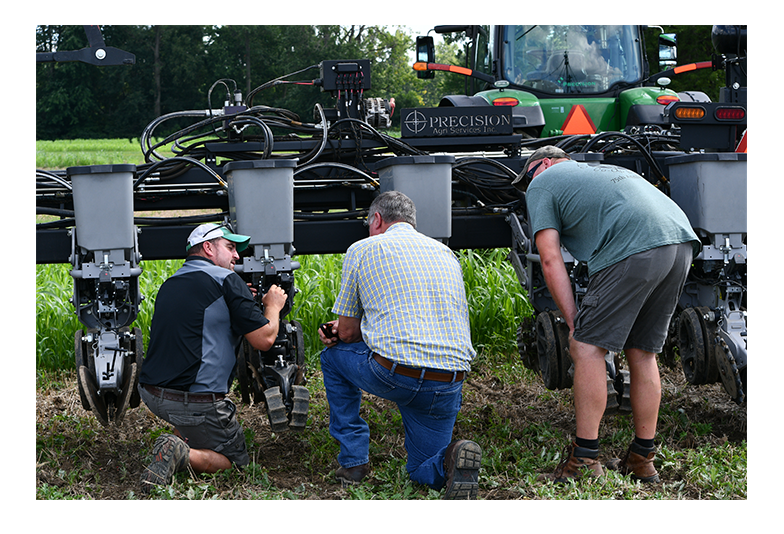
In modern precision agriculture, it’s easy to focus on the latest guidance systems or planting technology, but even the most advanced data can’t fix poor seed placement. The team at Precision Agri Services Inc. in Minster, Ohio, often reminds growers that “the most important pass you make each year is the planter pass.” Your seed has the highest yield potential before it is placed in the ground.
When your planter is properly maintained, every seed is placed at the right depth and spacing for uniform stands and maximum yield potential. In contrast, worn parts like parallel arms, gauge wheels, and disk openers quietly undermine yield long before plants even emerge.
Why Planter Maintenance Matters
A well-tuned planter is your best insurance policy for uniform emergence and strong stands. Research from DTN Progressive Farmer shows that yield losses can reach 20 bushels per acre in corn when components are worn.
Even small wear points cause depth variation, poor seed-to-soil contact, and delayed emergence. Plants emerging 24 hours later than their neighbors lose access to early moisture and sunlight, leading to smaller ears and lower yields (PASI studies).
Regular preseason inspection, especially in Ohio’s variable soils, ensures that every seed gets the consistent start it needs to thrive.
Parallel Arms: The Foundation of Row Unit Performance
The Role of Parallel Arms
Parallel arms act as the suspension system of your planter’s row unit. When they’re tight and properly functioning, they maintain steady depth across uneven ground. When worn, they introduce chatter and vibration that lead to uneven seed spacing.
How Wear Develops
Traditional bushings often wear out the arm housing faster than expected, creating play between components. Once that happens, replacing bushings isn’t enough. You’ll need a full rebuild.
Check: Lift your row unit and rock it back and forth. If there’s 3/8 inch or more of movement, it’s time to rebuild. (GBGI USA)
Modern Solutions
Upgraded systems such as GBGI Parallel Arms use two-part bushings where an inner sleeve rotates freely while the outer sleeve protects the arm. This dramatically extends lifespan and precision.
Expert Insight: Field tests by Precision Planting show that tight parallel arms improve emergence uniformity by up to 15%, translating into measurable yield gains.
Gauge Wheel Arms: Controlling Depth and Furrow Quality
Why They Matter
Gauge wheel arms control how the wheels press against disk openers to set seed depth and keep soil from entering the furrow. As arms wear, wheels begin to rattle and pull away, creating inconsistent planting depth.
Common Wear Symptoms
- Wheels wobble or bounce during operation
- The gauge wheel loses firm contact with the opener disc
- Depth varies from one row to another based on wear and proper adjustment
How to Check and Adjust
When lifted to planting depth, the gauge wheel should maintain light contact with the opener disc. You should feel slight friction when pulling it away (Kinze Manufacturing).
For John Deere and Kinze designs with pusher-style arms, this adjustment may need to be checked daily during planting, especially in clay-heavy Ohio soils that accelerate wear (YouTube).
Disk Openers: Creating the Perfect Seed Furrow
Function and Wear Patterns
Disk openers slice through residue to create a V-shaped seed trench. As they wear down from 15 inches to 14.5 inches, they lose their cutting edge and cause uneven furrows (Wearparts LLC). Some blades measure approximately 15.8 inches, and significant wear occurs after roughly ½ inch of diameter loss.
Worn blades also lead to residue “hairpinning,” creating uneven seed depth and delayed emergence.
Correct Blade Contact
Blades should have 1 to 1.5 inches of contact overlap. More causes friction; less creates poor trench shape. Also, check your seed tube guard. It should be at least 5/8 inch wide, and if it measures under 3/4 inch, it should be replaced.
Field Implications
When blades and guards wear out together, the trench narrows and seeds can bounce, preventing uniform placement. Precision Agri Services recommends replacing opener blades as needed per manufacturer specifications.
The Emergence Uniformity Connection
Uniform emergence equals uniform yield. Research from Precision Planting shows that even small delays in emergence—just 12–36 hours—can reduce yield by 11–28%. Clemson University evaluations confirm that uneven emergence limits overall productivity.
Small mechanical inconsistencies, especially in parallel arms and gauge wheel arms, are often the silent cause. Each worn part adds variation, leading to scattered emergence and lower yield potential.
We know that local information and research matters. During our planter clinics, we dig seed, pull plants.
Additional Maintenance Considerations
Closing Wheels
Closing wheels complete the planting process. Too much pressure compacts soil and hinders germination; too little leaves air gaps that delay emergence.
No-Till Systems
Ohio’s no-till systems require extra attention to residue management. Keep row cleaners adjusted to sweep residue without digging into soil, which causes crusting (Penn State Extension).
Post-Harvest Inspection
The best time to inspect your planter is right after planting. Look for uneven stands, skips, or doubled plants, which are signs of wear or calibration issues. Offseason maintenance prevents rushed repairs come spring (Iowa State University Extension).
FAQ
What are the first planter components I should inspect before planting?
Start with parallel arms, gauge wheel arms, and disk openers. They most directly affect seed spacing and depth consistency.
How often should I rebuild parallel arms?
Inspect annually and rebuild when there’s 3/8 inch or more of play or visible bushing wear.
How can I tell if gauge wheels are adjusted correctly?
Gauge wheels should lightly touch the opener blade and roll slightly forward when released (No-Till Farmer).
How often should disk openers be replaced?
Replace once blades show approximately 1/2 inch of wear from new diameter or when sharpness is noticeably reduced (Wearparts LLC).
Can uneven emergence be caused by factors other than wear?
Yes, soil temperature, moisture, and residue also affect emergence, but planter wear amplifies those effects (Bayer Crop Science).
Your planter sets the stage for your entire growing season. Tight parallel arms, snug gauge wheel arms, and sharp disk openers give every seed a fair start, and every acre its best chance to produce.
For Ohio’s corn and soybean growers, consistent emergence isn’t luck. It’s maintenance. Regular inspections and proactive rebuilds help ensure that your planter remains the yield-building machine it was designed to be.
Ready to make every seed count this spring? Connect with your local experts at Precision Agri Services Inc. in Minster, Ohio. Our team helps farmers across the region maintain and optimize their planters for consistent performance, season after season.
Contact us today to prepare your planter for a higher-yielding season.